


- Enhancing retrieval-augmented generation (RAG): RAG boosts AI accuracy and relevance by working with the data that’s most important to you, providing results that are more current, focused, and meaningful to your queries and tasks.
- Fueling agentic AI: Agentic AI acts like virtual teammates that can plan, decide, and take action on their own to get things done on your behalf, freeing you up for bigger challenges.
- Rapid prototyping: Quickly iterating on AI experiences powered by enterprise data.
- Replacing do-it-yourself data transformation pipelines: Building your own data transformation pipelines is time-consuming and error-prone.
- Unifying data silos: Eliminating data barriers and creating shared GenAI data layers.
- Continuous data delivery: Scheduling jobs, routing documents, and optimizing every task.
- Business process automation: Report generation, automatic responses, decision-making, content analysis, and more!
This 40-second video demonstrates a simple use case that Unstructured helps solve (no sound):
This 60-second video shows why using Unstructured is preferable to building your own similar solution:
You can use Unstructured through a user interface (UI), an API, or both.
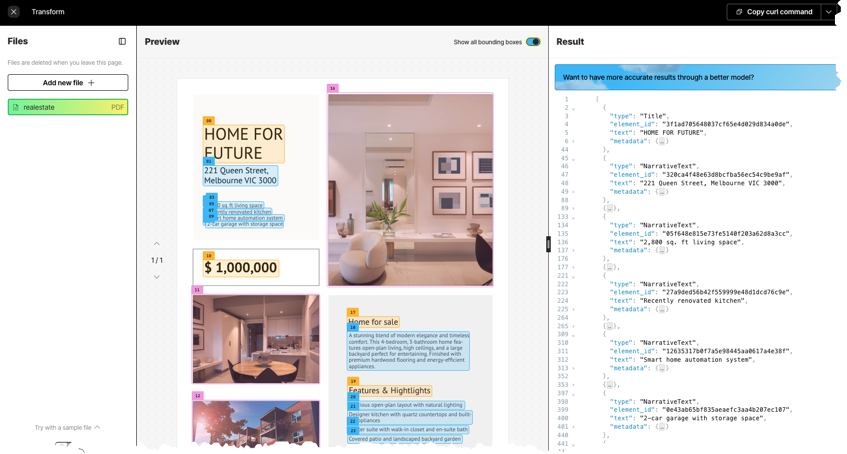
An example of the Unstructured user interface, showing a local file being partitioned
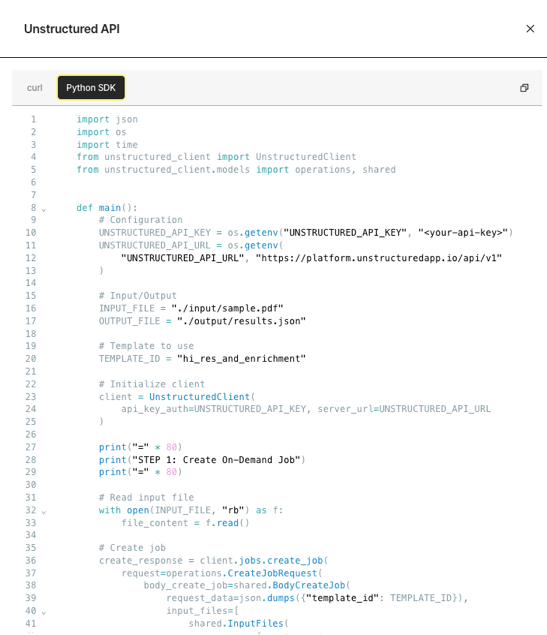
An example of the Unstructured API, showing the code to process a local file
Pricing
Unstructured offers different account types with different pricing plans:- Let’s Go and Pay-As-You-Go - A single user, with a single workspace, hosted alongside other accounts on Unstructured’s cloud infrastructure.
-
Business - Multiple users and workspaces, with three options:
- Business SaaS - Hosted alongside other accounts on Unstructured’s cloud infrastructure.
- Dedicated instance - Hosted within a virtual private cloud (VPC) running inside Unstructured’s cloud infrastructure. Dedicated instances are isolated from all other accounts, for additional security and control.
- In-VPC - Hosted within your own VPC on your own cloud infrastructure.
- For these file types, a page is a page, slide, or image:
.pdf,.pptx, and.tiff. - For
.docxfiles that have page metadata, Unstructured calculates the number of pages based on that metadata. - For all other file types, Unstructured calculates the number of pages as the file’s size divided by 100 KB.
- For non-file data, Unstructured calculates a page as 100 KB of incoming data to be processed.
Questions? Need help?
- For general questions about Unstructured’s product offerings, email Unstructured Sales at sales@unstructured.io.
- For Unstructured technical support, see Requesting support.